Selling at Scale: What It Takes to Run a $10 Million-Plus Land Auction
• 4 min read
The $10 million land auction is a different animal from the $1 million one — and not for the reason most people assume. The numbers are bigger, of course. But what actually changes is the work behind the scale: the number of qualified buyers who have to be reached, the number of tracts that have to be packaged so each one bids against every other, the legal and title complexity, the marketing footprint, and the discipline required to keep a sale moving without a single auction-day surprise.
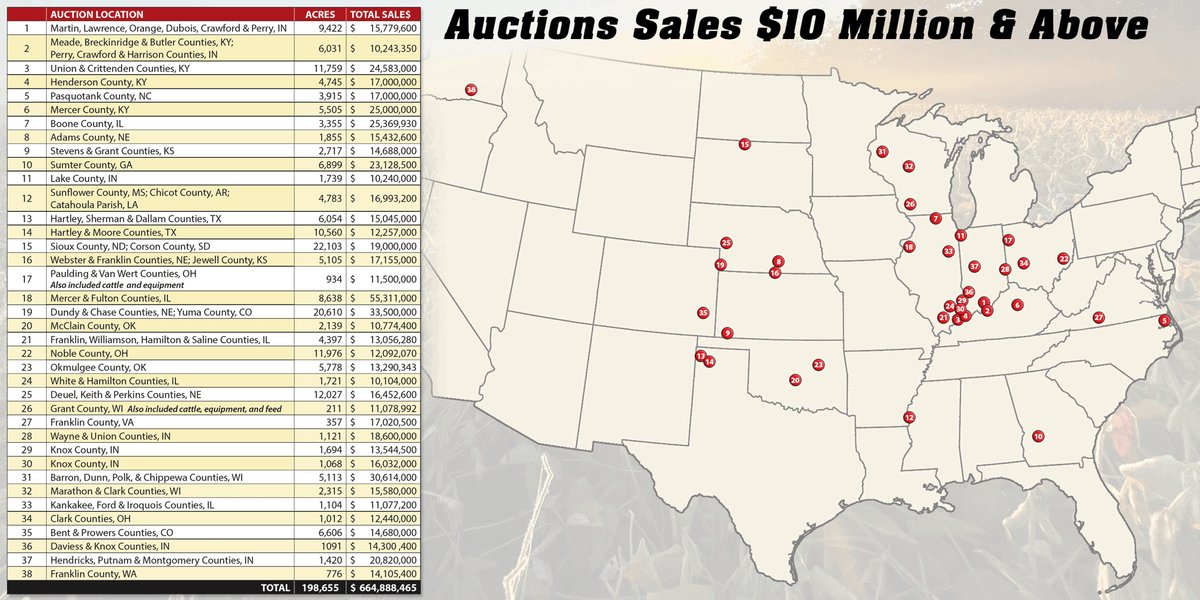
Schrader Real Estate and Auction Company has closed more than 30 auctions at $10 million or above, totaling over $660 million in combined sales. They span more than twenty states, from Washington to North Carolina and from North Dakota to Georgia. The pattern across that body of work is what this article is about — not the dollar figures themselves, but what has to be true on the ground for an auction at that scale to occur.
Most auction firms never run one
The eight-figure land auction is rare in the industry. Many regional firms will go their entire history without conducting one; many national firms have a handful. Schrader's track record at that level is the result of a deliberate model — in-house brochure design, an in-house mailing operation, in-house counsel, proprietary multi-tract bidding software, and an auction-management team that operates the sale itself rather than handing it to a contracted auctioneer. Each of those pieces was built specifically because, above a certain transaction size, the off-the-shelf approach stops working.
Scale is a tract-management problem, not a marketing problem
It is tempting to assume a $10 million sale is just a small sale with bigger advertising. It is not. The defining feature is almost always the number of tracts.
The FLF RE auction in Wisconsin (August 2023) is the clearest illustration. Run as two consecutive sessions across Barron, Dunn, Polk, Chippewa, Marathon, and Clark Counties, it offered 103 tracts totaling more than 7,400 acres and closed at a combined $46.2 million. CNX Land in Noble County, Ohio (October 2019) offered 65 tracts across nearly 12,000 acres and closed just shy of $12.1 million. New River Royalty across four southern Illinois counties (October 2018) packaged 89 tracts and closed over $13 million.
The point of running that many tracts is not to make the auction look bigger. It is to give every plausible buyer a tract that fits their checkbook and their operation, so that on sale day the room contains competing bidders rather than curious spectators. The multi-tract method — with combinations bid against individual tracts in real time — is what lets a 12,000-acre offering attract the small operator buying a quarter section and the institutional buyer assembling 4,000 acres in the same auction.
The buyer pool has to be assembled, not assumed
At $10 million and above, the buyer who closes is rarely walking in cold. The Anderson Circle Farm auction (Mercer County, Kentucky, November 2011) closed at $25 million across 5,500 acres. KB Farms in Boone County, Illinois closed at $24.6 million the same week. Blackshear in Sumter County, Georgia closed at $22.7 million across nearly 6,900 acres in early 2013. Each of those sales required identifying and qualifying buyers months in advance — through targeted advertising, industry relationships, and direct outreach to operators capable of writing checks that would actually close.
That work is invisible from the outside. It is also the difference between a $10 million property selling for $10 million and a $10 million property selling for $14 million. Uncertainty depresses bidding. A pre-qualified buyer pool, working from a complete information packet, empowers it.
Geography is not a limit
Schrader is headquartered in Indiana, but the eight-figure track record is national. Kasper Farms closed in Hartley and Moore Counties, Texas (March 2015) at $11.9 million across 10,560 acres. TWE-Thomas Land covered three Nebraska counties at $16.1 million across more than 12,000 acres. Van Ryn closed in Franklin County, Washington (November 2025) at $14.1 million. AEP RE in Franklin County, Virginia closed at $11.4 million. The same model that runs an Indiana farm auction is the model that runs a Texas ranch or a Pacific Northwest irrigated operation — the same brochure team, the same advertising operation, the same software, the same auction managers.
Equipment, homes, and mineral rights as part of the sale
Several of the eight-figure auctions were not pure dirt. They included farm equipment, working facilities, residences, or mineral interests sold alongside the land. Buffalo Hill in Adams County, Nebraska (November 2012) closed at $15.1 million as a working farm with equipment. Evans RE in Clark County, Ohio (March 2024) closed at $12.4 million across 1,012 acres including farm and residential improvements. Handling the asset mix in a single sale — rather than fragmenting it into separate auctions over months — is itself a function of running the brochure, the legal documents, the software, and the auction team under one roof.
What this means for a seller with a large holding
If you own a property that may sell at eight figures, the question to ask of any auction firm is not whether they can market it. The question is whether they have run the kind of auction yours will be — with the tract count, the buyer pool, the asset mix, and the geographic reach yours will require — and whether the people who ran those auctions will be the people running yours.
For Schrader, the answer comes from a track record measured in more than 30 auctions, over $660 million in combined sales, and more than twenty states. The methodology and concepts are similar to the ones applied to a 200-acre family farm. Although the scale of the property varies, the discipline does not.