

By Brooke Bouma Kohlsdorf, Successful Farming
The Britton family has owned farmland in west central Indiana for over 150 years - something few families in that part of the country can say. But in early September, the current generation decided it was time to open a new chapter and let others share in their family's legacy.
"This farm was well known in the community, and people really supported it. They knew the history," said Gene Klingaman of Schrader Real Estate and Auction Company.
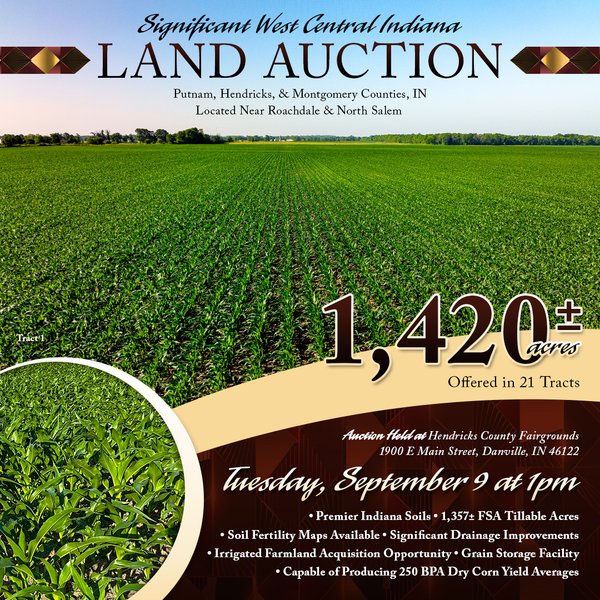
Klingaman led the sale of the 1,420 acres located about 45 miles west of Indianapolis, near the towns of Roachdale and North Salem. The property was divided into two large parcels, about five miles apart, and further broken down into 21 individual tracts for the auction.
The result? A strong showing: the land brought in an average of $14,661 per acre, totaling $20,818,620. According to Klingaman, the Britton family's decision to divide it into so many pieces wasn't just strategic - it was thoughtful.
"They wanted to give members of the community a chance to buy and continue the legacy," he said.
The Sale
Thanks to the size of the farm and the family's reputation, the auction attracted serious attention. Klingaman said 65 registered bidders filled the room, along with about 250 people who came just to watch. Online, more than 11,000 people viewed details about the property and the sale.
In the Schrader method of auction, the 21 individual tracts were bid in 34 different combinations by the competing bidders, which made for an exciting two-hour auction. When the dust settled, seven buyers - two investors and five local farmers - had each secured a piece of the property.
Sellers
Ed Britton, one of the family members behind the sale, said he and his siblings represent the third generation to own the land. Their family's story began just after the Civil War in the 1870s, when Ed's grandfather, Jesse Britton, purchased the first 20 acres and began farming to support his family.
Over time, Jesse and later his son Ray, expanded the operation. The Britton family added even more acreage during the 1960s, 70s, and 80s.
While Ed's brother Ted farmed in the early years, they eventually turned day-to-day operations over to two trusted tenants, taking on more of a management role. Ed credits those tenants for the farm's long-term success.
"We used a crop-share lease - what we called 'on the shares' - where instead of a fixed cash rent, the tenant gave us a percentage of the crop. It allowed them to take on less risk, and earn more during good seasons," he explained.
While letting go of the land was emotional, Ed said it was time. The property had been an important part of their lives and legacy, but the family wanted to make it available for others.
He reflected on a powerful memory from the past: "My father lived through the Great Depression. I remember him telling me he once couldn't borrow $100 from the local bank - not because he didn't qualify, but because the bank literally didn't have the money to lend. But they hung on, and we kept farming. We still are. It's been a wonderful blessing to us."
Klingaman noted that the Britton family was respected not just for their longevity, but for how they cared for the land.
"They were excellent stewards," he said. "People in the community recognized that."
Part of that stewardship included conservation improvements. In addition to traditional irrigation and drainage, the Brittons invested in controlled drainage systems - an innovative technology that improves water retention and reduces nutrient loss.
According to Ohio State University Extension, these systems work by adjusting the height of drainage outlets, allowing farmers to control how much water leaves the field. They also allow water to be saved underground for use during dry periods, making them more efficient than traditional above-ground irrigation due to reduced evaporation.
"Taking care of the land and being a good steward is just part of who we are?especially as Christians," Ed said.
Statewide Farmland Values
Farmland values in Indiana rose modestly this year, according to Purdue University's 2025 Farmland Value and Cash Rents Survey. The average price for top-quality farmland across northern and central Indiana reached $14,826 per acre, a 3% increase from June 2024.
Klingaman says quality farmland, like the Britton's land, continues to draw buyers.
"People are always looking for quality land. Anything of quality seems to hold its value," he says of land trends in his part of the state.
Closing Thoughts From the Family
Ed said his family is pleased with the outcome of the auction and especially glad that local farmers will continue to work the land.
Looking back on a life spent in agriculture, he shared one final reflection: "Farming is about family. And family is the most important thing we'll ever have. I don't care how much money you make or what success you find - God gave us family to get through the good times and the hard ones. That's what farming has always meant to us."